Saturday, September 27, 2008

Can the vet deliver?

"Today may be the last day you will see your Chihuahua alive," I said. "She has heart disease and had one episode of heart failure during anaesthesia two years ago during dental scaling. She may die on the operating table."

The dog needed to be revived during dental scaling. I had advised the quiet lady that the dog should not take "further general anaesthesia". I had noted this in my case record. Two years had passed and the dog now had pyometra.

Today, Friday Sep 26, 2008 was the day the Chihuahua was to be operated. She had antibiotics from me for the last 5 days and had seen Vet 1 six days ago. Pyometra was also diagnosed by Vet 1 who advised surgery and gave antibiotics and oral painkillers.

Antibiotics given some 3 weeks ago worked to stop the vaginal discharge. The owner was advised to get the dog spayed after one month. But at the end of 10 days of antibiotics, more "liver-coloured" vaginal discharge flowed continually. The dog had no appetite and needed hand feeding. She was losing weight and now had a fever. Therefore she was high anaesthetic risk. A type of case I would prefer to pass to other vets.

Anaesthetic deaths are so unpleasant events as vets get the blame. Newspapers loved to sensationalise the case too. There was a recent case of a Jack Russell that died on the operating table after being admitted for spay and dental scaling. I had not read this newspaper report but one complaint in the newspapers was that the vet still charged his fee even though the dog had died. No delivery of a good service, no payment?


I had spoken to the quiet lady and her husband for some time on the 2nd recurrence of vaginal discharge 5 days ago after cessation of antibiotics and the emergency visit to Vet 1. When was the optimal time to operate? It was hard to define exactly. I advised that once the dirty and sticky vaginal flow ceased, the dog should be operated. The time was 5 days after antibiotics.

So the dog was here now. She has fever. Still would not eat by herself and had lost 0.3 kg during the past 2 weeks. She still looked alert.

"I will wait at the surgery," the quiet lady said.

"It is best you go home," I said. "Waiting at the surgery is very stressful for me in such situations of high risk anaesthesia. I need to focus on the dog surgery and if you are hanging around, the atmosphere is very tense."

The lady went home. She might be seeing her pet alive for the last time. There was no way I could be less frank. "Do your best," the husband phoned some 30 minutes later to enquire about the dog but I had not operated yet. His wife was very upset at the thought of the dog not being able to be alive from general anaesthesia.

Anaesthesia and Surgery of this high risk anaesthetic case.


1. Dextrose saline 200 ml SC, antibiotics and anti-fever injections given.
2. Pre-operation shaving and washing of operation done. Let the dog rest for some minutes.
3. Gas mask anaesthesia starting at 5%. Reduce to 1.5% after intubation. The dog was too light as she moved. Increase to 2% but not more and wait to staablise.
4. Incise 2 cm from umbilical scar. Make incision 2 - 3cm caudally. Hook up left uterine horn which could be seen easily from this bigger incision. I used the scalpel to cut the tight ovarian ligament. Ligate ovarian blood vessel. Take out the right uterine horn and repeat same procedure. Get the uterine body out. 3-clamp method. Ligate below clamp 3 after clamping the horn. Ligate the crushed area after removing clamp 3. This meant that there would be two ligations.
5. Reduce gas to 0.5% to effect. Stitched linea alba. The dog reacted to pain. Increase to 2%. Reduced to 1% to effect.
6. Reduced gas to 0.5% when the skin incision is stitched. Switched off gas at the 2nd last skin incision.
7. Dog woke up without crying, as if from a deep sleep, after the placement of the last skin stitch.
8. Placed dog in a quiet cage. The cyanotic tongue was not a good sign. This dog did not have sufficient haemoglobin in her red blood cells according to a blood test some 3 weeks ago.
9. The owner took the dog home some 1 hour after surgery. She could care for the dog better at home.


Surgery can be shorter if one follows the Formula One teams where each person handles a specific task when the sports car comes to the pit stop. My assistant focused on the anaesthesia. Another assistant held the forceps to lift up the ovaries for me while I ligate.

In this case, the dog's heart did not fail and she recovered and went home. If she survived the next 48 hours, she should be regaining her appetite after the toxic womb had been removed and should live a long time as her care was excellent. As for her tartar in her canine and other teeth, I dared not suggest any dental scaling or did any scaling after the removal of the womb. I don't advise such procedures although it does save money for the owner. The shorter the anaesthesia, the better the outcome.


What the owner wants is a live dog at the end of anaesthesia. Pets are family.

If the vet cannot deliver, there will be much sorrow on the part of the caregiver of the pet. And unpleasantness from family members and sensationalism in the tabloids and internet forums.

Thursday, September 11, 2008

13. Follow up to Post 11. Seizure in the Maltese

http://www.toapayohvets.com/surgery/20080815Maltese_
Uroliths_Male_ToaPayohVets.htm
is the webpage documenting the Maltese's bladder operation to remove numerous green stones.Clinical Case Study: Toa Payoh Vets

BLADDER STONE REMOVAL SURGERY ON AUGUST 5, 2008
1. General anaesthesia. IV drips.
2. Skin incision cranial to prepuce
3. Linea alba incised
4. Bladder hooked out or use forceps. Bladder was empty.
5. Ventral surface of the bladder was incised, between large blood vessels seen on the bladder wall.
Maltese, Intact Male, 5 years. Stones must be flushed out thoroughly. Toa Payoh Vets
Cystotomy. Surgical approach in this case was via the dorsal wall of the bladder as contrasted to the ventral approach in the Miniature Schnauzer case of the young lady.

Both approaches are acceptable. The ventral approach is easier, in my opinion. Some vets believe that there will be less pressure on the bladder if the dorsal approach is used.
Maltese, Intact Male, 5 years. Incision to access the bladder. Toa Payoh Vets


6. Forceps to pick out as many stones as possible, esp. large ones.
7. Insert catheter into urethra to bladder.
8. Flush 20 ml of Hartmann's solution via catheter into bladder. More stones are flushed out. Repeat.
9. Clamp incision with forceps and flush Hartmann's solution to distend bladder.
10. Release forceps to let stones flush out. Numerous sandy ones. Repeat.
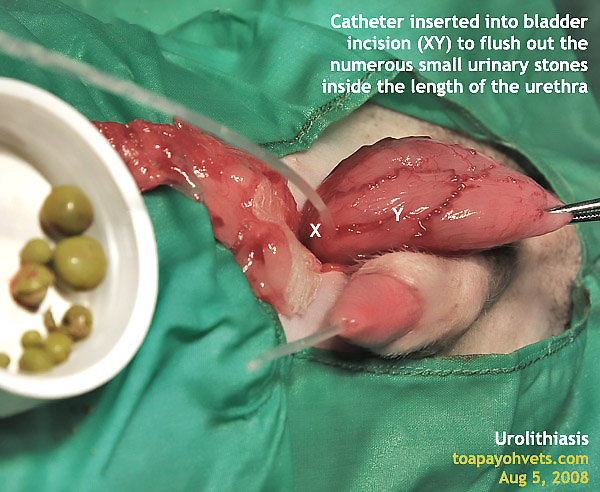
11.Insert catheter via bladder to urethra and flush stones along the length of the urethra out. Numerous small sandy ones.
12. 2 layers of inverting stitches 3/0 dissolvable. Not to stitch into mucosa.
Mucosa looks white. Bladder wall is thickened.
13. Flush 10 ml of Hartmann's solution into bladder via catheter. No leakage seen as bladder distends. Repeat.
14. Close skin.
15. Collar. No need catheter.

Dog is active and normal as at August 9, 2008. Any person interested in adopting him, please e-mail
judy@toapayohvets.com

UPDATE AS AT AUGUST 9, 2008 (National Day, Singapore)

The urinary stones in this Maltese were removed by cystotomy.

However, there is no guarantee that he will not get a similar problem another time. X-rays after the surgical removal of stones and every 3-6 months are ideal. 2-weekly urine tests for the next 3 months are recommended to check for bacterial infection and crystal formation.

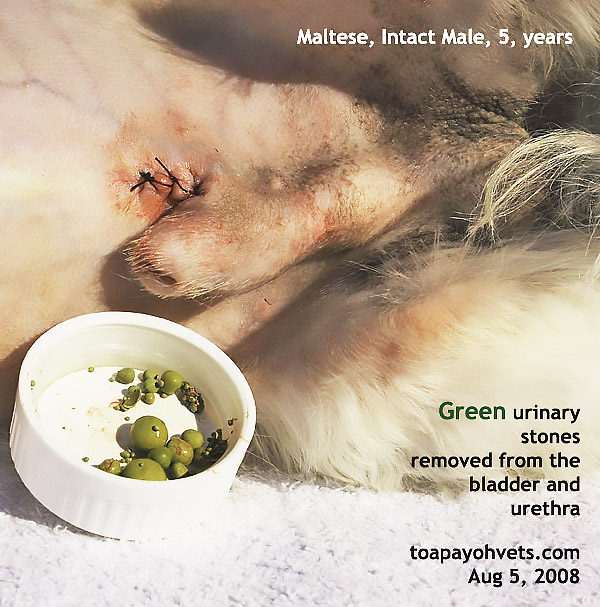
Absence of crystals in the urine or X-rays do not mean that the dog has no stones (>100 numerous green ones)


Friday Sep 12, 2008

http://www.toapayohvets.com/surgery/20080815Maltese_
Uroliths_Male_ToaPayohVets.htm
is the webpage documenting the Maltese's bladder operation to remove numerous green stones. He was adopted by a dog lover who has a female Maltese some 2 weeks ago.

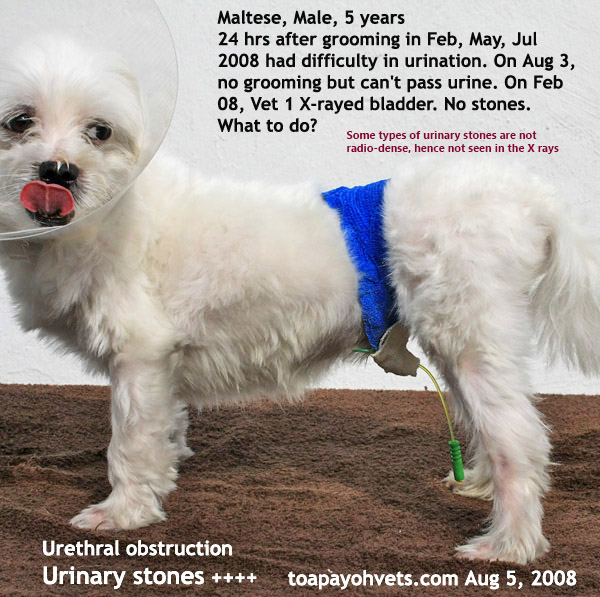
On Wednesday Sep 10, 2008, the Maltese had a seizure for around 3-5 minutes and was brought to the Surgery in the evening. He was warded for the next 36 hours and had no seizure. He was extremely energetic.

The cause of seizures are not easy to say. He did have a seizure prior to his urethral obstruction according to the son of the patriarch who did not want him. Therefore this is his second seizure.

"Could he be having too much sex?" the new owner surprised me with his observation that the Maltese had been trying to mate the female Maltese. Both were sniffing each other for the past few days but she did not permit him to mount her.

"The female is not receptive for the first 7-10 days of estrus," I said. "So the male must be exhausted. Did he eat?"

I asked because this dog may have hypoglyceamia or low blood sugar if he does not eat twice a day. Some small breeds like the chihuahuas do suffer from such a condition.

"The female ate his food in the evening, as he did not eat it. He was not interested in his food." The male Maltese may be getting seizure soon and did not have the appetite.

As the cause of seizures are unknown in most cases, it is hard to treat. The Maltese had no seizures for the past 36 hours and went home.

"What should I do if he has a seizure again?" the new owner asked. "The dog keeps banging his head on the floor."

"For dogs with seizure, try to prevent the dog from injuring himself. For the small breed, it is possible to wrap him in a blanket and protect his head from injury. The owner is give a diazepam tube to stop the fits is used to pump the drug into his rectum.

In this Maltese, I suspect that extreme pain as in urethral obstruction earlier or exhaustion as in recent seizure could be the triggering factor. He had been warded in the Surgery for a few weeks till he was adopted 2 weeks ago. He never had fits. Neither did he have the sexual tensions too.

This dog needs to be monitored. As far as more X-rays and urinalysis to monitor the recurrence of bladder stones, many Singapore dog owners are not willing to spend money and time to do the monitoring.

The cost of living for the ordinary people in Singapore goes up every year. So veterinary advices are frequently ignored.

Friday, September 5, 2008

Caesarean Sections - Toa Payoh Vets

DRAFT

Caesarean sections - Dr Sing Kong Yuen, Toa Payoh Vets

Sep 3, 2008
The following searches from Google showed 12 pages related to Caesarean sections done by Dr Sing Kong Yuen over the past years at Toa Payoh Vets. From 2004 - 2006, I had numerous Caesarean sections from most of the dog breeders in Singapore.

1. http://www.asiahomes.com/singaporerealty/expat/analysis/analysis-6.htm
2. http://www.toapayohvets.com/tpvets_Jul904.htm
3. http://www.asiahomes.com/singaporetpvet/sales.htm
4. http://www.toapayohvets.com/fees.htm
5. http://www.asiahomes.com/singaporetpvet/dogs/030607umbilical_hernia_Singapore.htm
6. http://www.asiahomes.com/new1/puppy_Mar2004.htm
7. http://www.asiahomes.com/singaporepets/031026two_waterbags_Silkie_Singapore.htm
8. http://www.asiahomes.com/singaporeaur/0532condos_East.htm
9. http://www.asiahomes.com/Email_house_listing/house_listing2.htm
10. http://www.asiahomes.com/singapore_condos2000sf/
11. http://www.asiahomes.com/singaporerealty/0515hunting_$4K.htm
12. http://www.asiahomes.com/singaporetpvet/services.htm
13. http://www.asiahomes.com/singaporetpvet/dogs/030518pomeranian_caesarian_section_Singapore.htm
The Single Pup Syndrome
14. http://www.asiahomes.com/dev/Atomic_031215elective_caesarean.htm
Elective Caesarean sections save puppies
15. http://www.asiahomes.com/040113Yorkshire_explosion.htm
The Yorkshire Terrier had an explosive Caesarean section
16. http://www.asiahomes.com/singaporetpvet/031109spay_bitch_Singapore.htm
Spay or get breast cancer
17. http://www.asiahomes.com/singaporepets/Atomic_031214caseareans_large_litters.htm
How to be successful in canine breeding. 3 Caesarean cases
18. http://www.asiahomes.com/singaporetpvet/54thday_Chihuahua.htm
Will oxytocin save the mother's life?
19. http://www.asiahomes.com/Email_house_listing/house_listing2.htm
No puppies can survive 40 degrees C
20. http://www.asiahomes.com/puppy.htm
21. http://www.asiahomes.com/singapore-rent/030306Queens_condos_Singapore.htm
Dog transport man Ah Chye

Friday, August 8, 2008

11. Follow up on Post 10. Maltese is normal after surgery.

In response to 2 comments:

http://www.toapayohvets.com/surgery/20080815Maltese_
Uroliths_Male_ToaPayohVets.htm
has the details of the surgery to remove the bladder stones.

As at Aug 9, 2008, the Maltese is living a normal life now.

Thursday, August 7, 2008

10. Money back as dog could not pee

"If your car can't move after returning from the mechanic, what do you expect?" the trim man in his 60s asked me as I was about the leave the Surgery at the end of a long day. Without waiting for my reply, Mr Lee said, "Surely you expect the mechanic to repair your car till you can drive it. Free of charge."

A veterinarian who had warded his dog for 3 days had released the dog to him. "Look, look, no urine came out," the man directed my attention to the small mini-Maltese cocking his right leg against the wall of a column for a few seconds."

"This is the first time I see your dog. I don't know anything about your dog treatment," I said, not wanting to get involved with potential litigation. "You will have to talk to your vet." I went back to the Surgery to collect my things.


Mr Lee knocked on the glass panels in front of the Surgery to attract the attention of Mr Saw, my vet technician who was at the waiting area doing some administration work. "Ta boleh kenching (Cannot urinate in Malay)," he cricked his knucles onto the glass panels and shouted from outside.

I went out of the Surgery: "No point talking to Mr Saw. He is not a veterinarian in Singapore. He does not speak the Malay language. He is a Myanmarese." Mr Saw had been mistaken for an Indian and now as a Malay as he has sunburnt tanned skin.

If possible, I would help to resolve any dispute affecting the veterinary profession even if the veterinarian is from the competition. I spent some time finding out what Mr Lee wanted.

"All my money back," he said. "After all, the dog still cannot pee and I still paid the fees. If your car goes to the mechanic and he cannot repair your car, you ought to get your money back."

Mr Lee went on about the roles and responsibilities of the mechanic. Non performance, money back guarantee.

"Well," I said. "You really have to speak to your vet directly if you want your money back. He had done a lot of work. I don't know what really happened."

Mr Lee said, "I understand that this vet had a business to run and has his overheads." He waved a veterinary bill for me to see, "I don't know whether he had really given the drugs or treatment to the dog. Vet 1 (the first vet) who treated him had said there was no bladder stones and after his X-ray, the dog could pee normally for some weeks. On another occasion, I went to Vet 1 and he prescribed some antibiotics without seeing the dog. The dog could pee normally. Last week Vet 1 refused to give me the antibiotics. He wanted me to bring the dog down for examination. I came to consult Vet 2 because he is nearer to my home."

I had no comments about the actions of Vet 1 and 2 and should not comment on professional matters I had no idea about.

I said, "Mr Lee, how much money do you want back from Vet 2?"

"All my money," Mr Lee said. I shook my head, "Vet 2 had spent time and did work on your dog. I don't know what he advised you. The only thing I can do for you is to phone him and ask him for some money back for you."

Mr Lee nodded his head.

Vet 2 said to me when I phoned, "Mr Lee had contacted me some 20 times. The dog has urinary stones and need a cystotomy."

"Can you give him back some money so as to resolve the matter?" I asked. "Negotiate."

Vet 2 said in some serious tone, "I am non-negotiable."

I focused him on the problem of money without wasting time on listening to his treatment because it was none of my business. Mr Lee wanted was "money back".

"Negotiation is the best way in this case. Give Mr Lee a counter-offer," I urged Vet 2. My experience in Singapore real estate helps me a lot in matters of negotiation in sales and purchases of houses.

"This dispute can be resolved with money and you will never see Mr Lee again." I advised. I did not want to say much about the ugliness of veterinary investigation by the authorities and prospective litigation as all veterinarians in practice would have had suffered some time or another. I presumed Vet 2 had never encountered such ugliness personally.

However, giving money back is perceived by some owners to admission of guilt or negligence. So, if Vet 2 stood his ground, I could just go home. Still I talked to Vet 2 to advise him to give back some money to avoid all unpleasantness and paperwork of veterinary investigation and litigation. It would cost more than $1,000 to engage a lawyer to defend Vet 2 and how about the tremendous amount of time involved in case writing?

Here we are talking of giving back around $100 back to the owner.

"50% back," Vet 2 said. I conveyed the message to Mr Lee. "80%," Mr Lee said. I asked Mr Lee to sit on the chair and talked to him. "Vet 2 had told you that your dog had bladder stones. Even though Vet 1 had said there were no bladder stones some months ago and that antibiotics cured the dog, it is Vet 2's diagnosis that the dog has bladder stones. Veterinary surgery for bladder stone removal and other tests would be expensive."

Mr Lee did not wish to proceed further with surgery, "I sell this dog to you,"

"I am sorry to say that a 4-year-old mini-Maltese has no commercial value," I said. "As a puppy he might sell for $800 but once adult, very rarely will anybody pay to buy him."

Lots of talking proceeded. "Veterinary expenses for a dog is much lower than bringing up a child," I said. "When children grow up, they don't pay the parents back the large amounts of money spent on educating them. They have their families to support and so do not give any allowance to their parent. Is that right, James?"

James is a 73-year-old working as a receptionist for me. James nodded his head.

"No, no" Mr Lee disagreed, shaking his head vigorously. "My son gives me money." He took out a worn out name card of his son who had worked for a foreign multi-national bank. Then another card of his new job with a premier financial institution."

"You are one fortunate father," I said. It was past 7 p.m. A lady in shimmering brown dress and high heels was seen at the glass panels of the entrance. She walked in.

"Look at this pretty lady," I pointed to the young woman well dressed and in the prime of her life. "Her dog had urinary stones and could not pass urine 2 months ago. Then after the operation, the dog could not pass urine 3 days ago. Now she is taking her dog home from the Surgery. She spent a lot of money on treating him and he might have problems not able to pee again."

I gave some instructions to the young woman as to how to care for her Miniature Schnauzer. She rolled her eyes upwards as she read a long lists of what to do to prevent recurrence and to give prescription diets on medical dissolution of the struvite stones.

Mr Lee was watching intently. She paid around $600 inclusive of the X-rays and 20 cans of prescription diet. On paper, it seemed that $600 was for 3 days of warding and treatment at the Surgery by me. What a large amount for a dog that can't pee again.

From Mr Lee's encounter, I asked the young woman to put the dog down on the grass to see whether he could pee normally or not. The Schnauzer sniffed here and there. After one minute he wandered further away and the young lady followed him.

"He peed normally," the young lady said as it was too dark for Mr Lee and I to see. It was nearly 7.30 p.m.

"Do you want this Maltese?" I asked the young lady. You need to get this dog surgery tor remove his bladder stones."

"I have 3 dogs," she said. "I can't take this one."

Mr Lee decided to give me his Maltese. No point throwing good money after bad, in a case of a Maltese that now had problems. Now, what to do with this dog? Nobody wants him. Euthanasia is the only option.

UPDATE AS AT AUGUST 9, 2008.
The urinary stones in this Maltese can be removed by surgery. However, there is no guarantee that he will not get a similar problem another time. X-rays after the surgical removal of stones and every 3-6 months are ideal. 2-weekly urine tests for the next 3 months are recommended to check for bacterial infection and the pH of the urine. Absence of crystals in the urine as in this case (urine sent for checking prior to surgery) do not mean that the dog has no stones (>100 numerous green ones).

SURGERY ON AUGUST 5, 2008
1. General anaesthesia. IV drips.
2. Skin incision cranial to prepuce
3. Linea alba incised
4. Bladder hooked out or use forceps. Bladder was empty.
5. Ventral surface of the bladder was incised, between large blood vessels seen on the bladder wall.
6. Forceps to pick out as many stones as possible, esp. large ones.
7. Insert catheter into urethra to bladder.
8. Flush 20 ml of Hartmann's solution via catheter into bladder. More stones are flushed out. Repeat.
9. Clamp incision with forceps and flush Hartmann's solution to distend bladder.
10. Release forceps to let stones flush out. Numerous sandy ones. Repeat.
11.Insert catheter via bladder to urethra and flush stones along the length of the urethra out. Numerous small sandy ones.
12. 2 layers of inverting stitches 3/0 dissolvable. Not to stitch into mucosa.
Mucosa looks white. Bladder wall is thickened.
13. Flush 10 ml of Hartmann's solution into bladder via catheter. No leakage seen as bladder distends. Repeat.
14. Close skin.
15. Collar. No need catheter.
16. Dog is normal as at August 9, 2008. No problem peeing. Eating well.


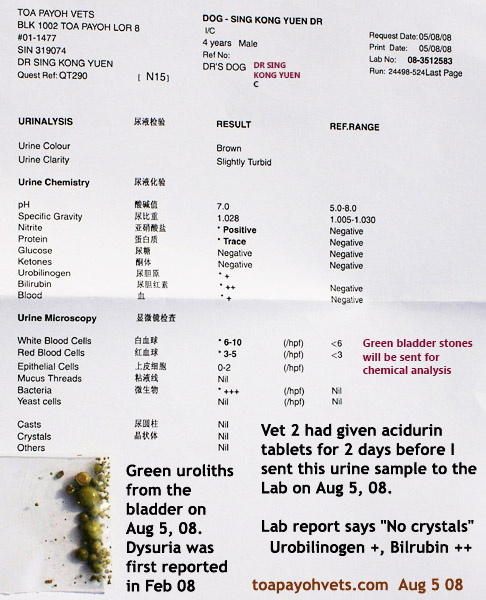
URINE ANALYSIS
Urine was sent to the laboratory for analysis prior to surgery.
No crystals in the urine in the report. No crystals do not mean that there are no urinary stones! Many stones.

Tuesday, August 5, 2008

9. Beginning of a urethral obstruction by urinary stones in this Jack Russell?

--- On Mon, 8/4/08, ...@gmail.com> wrote:

Subject: Regarding Neuter of Jack Russell
To: judy@toapayohvets.com
Date: Monday, August 4, 2008, 10:29 AM

Hi Dr Sing

(I can't seem to find the email for Dr Sing, could you put this email through to him, thank you very much, :) )

This email is regarding the neuter of my 3year old jack Russell terrier some time late May, XXX. After 3 weeks the blood clot has subsided. Till now all is well and his is also less aggressive and more good natured now. However.. every time I return home, Pepsi would greet me enthusiastically as usual. But after a while, he would stop to lick his genitals. I have noticed that there seems to be another set of testicles, which seems to have emerged from nowhere. It would appear at the middle along the penis.Is this normal? Everything else has been normal and his wound is completely healed.

I look forward to your reply. Thank you!

Owner


Flag this message
Re: Regarding Neuter of Jack Russell
Tuesday, August 5, 2008 11:17 PM
From:
This sender is DomainKeys verified
"David Sing"
View contact details
To:
...@gmail.com>


Thank you for the feedback.

It is hard to diagnose by internet. As the dog is very fierce, it is hard for him to come to the surgery to be examined properly. Do you mean there are two swellings?

From your description, the area is probably above the os penis (penile bone). If the male dog licks that area, it is possible that he has had some small urinary stones stuck behind the os penis. If he can pee normally, there is no problem. However, he may pee abnormally sometimes. Do observe him well. Here are my recommendations:

1. Use a sterile syringe, collect the urine for analysis.
2. Come to the Surgery to get a urine collection bottle to put the urine in.
3. The urine will be sent to the Lab for analysis for urinary stones and bacteria.
3. E-mail me a picture of the area involved (front view & side view).


http://www.bekindtopets.com/dogs/20080808Aggressive_Jack_Russell_neutered_ToaPayohVets.htm
is the case report.

Tuesday, June 24, 2008

8. Old female unspayed dogs "on heat" bleeding

From: ...@singnet.com.sg>
Subject: Question re Dog Licking Herself More Often
To: drsing@toapayohvets.com
Date: Tuesday, June 24, 2008, 6:31 AM

Hi Dr. Sing,

It has been a while since we last corresponded.

Can I please get your advice as my dog Coco has been licking her private parts
more often recently? There's no discharge on the floor, and she's
eating per normal and active as usual. Normal urine and poo too. However when I
check inside her vulva, I see a clear discharge. It isn't much and
doesn't ooze or drip out of her body too.

Her vulva is not swollen or red; it is just normal in colour with one or 2
faint tinges of pink. When I check, her vulva feels soft to the touch, but the
part right after that, i.e. the area between the vulva and the anus, feels
firm/hard to the touch. Is that normal?

Is
there anything I should worry about? FYI, Coco is 9 years old and unspayed.

Could her licking be related to the possibility of her coming into heat soon?

My dog's last heat was in Feb 8 through 25. The one before that was in Sept
23 through Oct 11. It was 5 months or 20 weeks between last year's heat and
the most recent one in Feb. Do you think my dog is going on heat again soon?

When does a female dog start licking herself before her season? 2 weeks before
or?

Please advise. Thanks very much!

Best regards,
Name given


Back to Messages
Re: Question re Dog Licking Herself More Often - PYOMETRA
Tuesday, June 24, 2008 9:20 PM
From: "David Sing"
To:
...@singnet.com.sg
Cc:
drsing_98@yahoo.com


Most likely on-line diagnosis (which is not recommended or advised) is that your dog is suffering from open pyometra. In this condition, the womb of the old dog has been infected by bacteria. Large amounts of pus are produced inside the uterine tubes.

Toxins from the bacteria get into the bloodstream to damage the kidneys and other organs. In time to come, the dog cannot cope with the licking away of the copious flow of vaginal discharge. The dog gets septicaemia and starts vomiting more and more often.

The only treatment of pyometra is surgery to remove the womb and ovaries (spay). Pyometra can be an emergency in many cases as many Singapore owners delay treatment thinking that the unspayed female dog is just having heat.

I just had a 12-year-old Golden Retriever with "heat" 2 months ago. (I presumed the dog licked her vaginal discharge so the owner did not see any more discharge). 2 weeks ago, sticky yellow vaginal discharge attracted flies which would not be swatted away. She vomited 2 days before surgery. Would not eat.

Depending on its health status, some dogs die before, during or after surgery. As many Singapore pet owners consider spay as "cruelty" but are uneducated as to what is pyometra, they often seek surgical treatment very late and the vet sometimes gets blamed for the death of the dog during or after surgery.

In your case, you have no choice but to see your vet and get a professional examination and opinion. It seems that your unspayed dog has been infected for some weeks. Female dogs spayed when they are young will not get pyometra for obvious reasons - they don't have the womb. There are pros and cons of spaying.


SUNDAY JUNE 29, 2008

CASE: 9-year-old Lhasa Apso. Not spayed.
Presenting sign: Vaginal discharge.

History: Licking vulva for past few days.
Previous heat around 5 months ago.

Examination. No thick copious vaginal discharge at consultation. Dog could have cleaned herself.
Fever: No. Active and eating. Urine said to be clear although there may be cystitis from a recent urine analysis.Bladder wall not palpable nor is bladder full.

Palpation: Acute pain in bladder/uterine horn area.

Diagnosis: Pyometra (open) and possible cystitis (bladder infection). It is possible that the dog had been licking off the pus. Usually pyometra starts 4-8 weeks after the previous heat. The owner noted that the vulval-rectal skin area is thickened. This is due to continuous irritation by licking for some weeks.

1) On which day after surgery can we stop worrying about whether she jumps, stretches or runs, for fear that her stitches come apart? When can we rest assured that we can leave her to move around as normal?

10 DAYS WILL BE THE BEST. Most dogs move around with no problems (90%) on day 2 in my experience.


Since I will arrive in the evening to collect my dog, only after you have left for the day, would you be kind enough to give me a call on my mobile to let me know how she is after the surgery?

OK. Must ask my people to phone you and do this as a routine. Most times we don't phone when there is no bad news. NO NEWS IS GOOD NEWS?

Will there be any pain killers for her after the surgery?
YES


2) Wound.

Will there be visible stitches on both the nipple and abdomen areas? You mentioned in your blog that these will dissolve on their own, but when do they go away, so that we can't see them anymore?

STITCHES DISSOLVE IN 21-35 DAYS. YOU CAN REMOVE THEM OR WE REMOVE THEM AT DAY 14.

How long do you think the incision for removing her womb will be?
ESTIMATED FOR LHASA APSO LENGTH OF INCISON TO BE 4 CM. IN YOUR CASE, IF THE INFECTION HAD GONE AND THE WOMB IS BACK TO ALMOST NORMAL SIZE, I CAN HOOK IT UP. INCISION WILL BE LIKE THE USUAL SPAY INCISION. AROUND 1-1.5CM.

IT IS POSSIBLE THAT I CAN HOOK THE WOMB OUT IF IT REVERTS TO NORMAL SIZE AFTER ANTIBIOTICS. IN SUCH SITUATIONS, THE BEST TIME TO SPAY HER IS 1 MONTH LATER.

IF YOU CAN BE OBSERVANT, WAIT 1 MONTH AS THIS IS AN OPEN PYOMETRA CASE PROBABLY. THEN I WILL JUST SPAY HER AS AN ORDINARY SPAY. SKIN INCISION WILL BE 1.0 TO 1.5 CM IN THIS SITUATION. YOU NEED TO DECIDE YOURSELF.

IN CLOSED PYOMETRA (pus stuck inside the womb as the cervix is closed tight, pus accumulates), NOT ADVISABLE TO WAIT.


On which day after surgery can we bathe her without worrying about her wound/stitches?

FROM DAY 2 AS THERE IS A PLASTER COVERING INCISION.

3) Breast Lump

Will you be sending the minute breast lump to the lab to see whether it's benign or malignant? If you don't, since the additional cost may not be worth it, would you be able to tell from your professional perspective and experience your best opinion on the nature of the lump, just by looking at it?

CAN'T TELL WHETHER IT IS MALIGNANT OR BENIGHT, FROM LOOKING ESP. WHEN IT IS SUCH A SMALL TUMOUR OF LESS THAN 0.5 CM. DIAMETER. ONLY HISTOPATHOLOGY BY THE AVA LAB WILL CONFIRM.

4) E-Collar

On which day after surgery can we remove the E-collar? Do we need to keep it on her even at night when she sleeps? How many days must she wear it?

USUALLY NO NEED E-COLLAR IF GIVEN PAIN KILLERS. HOWEVER, KEEP IT ON FOR 2 DAYS. IF PLASTER IS NOT LICKED AWAY, AS SOME FEMALE DOGS DON'T BOTHER, THEN NO NEED E-COLLAR. THIS LICKING IS UNPREDICTABLE AS NO 2 DOGS BEHAVE THE SAME AFTER SURGERY.

YOU HAVE GOOD QUESTIONS FROM THE OWNER'S POINT OF VIEW. WILL NEED TO GO OFFLINE TO GET TO WORK. MANY QUESTIONS ABOUT SURGERY ARE BEST ANSWERED BY WRITING THAN BY PHONE. I will need to include the answers in my case study so that others in your situation may benefit.

IT'S 8.30 AM. NEED TO GO TO WORK. BYE.