http://youtu.be/fPYGTq19LIE
The owners want to know the exact cause of lameness in their wire-haired Fox Terrier who has been limping on the right fore leg for the past 14 days. I palpated the right fore paw and flex, extend, abduct and adduct all the joints from the shoulder to the toe of the right fore limb. There was extreme pain in the 3rd digit of the right fore paw as evident by the "biting" reaction of the dog. X-ray was advised and taken, showing no fracture but a soft tissue swelling 4X normal.
Tentative diagnosis is paw abscess or inflammation due to a penetrating wound 14 days ago. Practise evidence-based medicine (X-tay in this case) to aid in the diagnosis of lameness in the dog.
The dog is given medication and should recover in 14-30 days.
The dog had impacted anal sacs and a large amount of dark brown anal sac oil was expressed. Signs of anal sacculitis were biting of the hind limbs and inside the thigh in this dog. The owner decided on clipping bald to get rid of all the infected hairs. Hence you will see a bald Fox Terrier on Day 2 in the video. The clipped Fox Terrier had anti-inflam and antibiotics injections 12 hours ago but is till hopping. He will be re-examined again in Part 2 of the series.
In Part 2, the pain in the right fore leg paw is much more evident as the gentle Fox Terrier, not muzzled this time, tried to bite the vet during manipulation of the 3rd digit.
More Be Kind to Pets vet educational videos are at www.toapayohvets.com/videos.htm. .
Wednesday, December 11, 2013

Sunday, August 8, 2010
51. When to operate on a closed pyometra case?
SUNDAY'S CASE
August 8,2010
Sunday, August 8, 2010
Consultation at Vet 1.
The 9-year-old, 5-kg Jack Russell passed out some sticky vaginal discharge and also blood in the stools on Saturday. The young lady and her brother googled "pet clinic" and went to North-east Singapore.
Vet 1 shaved bald the dog's ventral area for an abdominal ultrasound scan. "Lumps of around 3 cm in diameter can be seen", he told the owner. Vet 1 diagnosed pyometra based on vaginal discharge, fever, abdominal palpation and scan. Surgery and anaesthesia quoted was $1,000.
The kind vet advised surgery as soon as possible and presented the young lady a list of vet practices in Singapore. She was living in Toa Payoh and phoned me for a quotation. I was surprised when she told me that she did not know of Toa Payoh Vets existed (since 1982) although she is a Toa Payoh resident.
CHANCES OF SURVIVAL
It is difficult to guarantee 100% survival. The dog had actually been vomiting occasionally in the past 3 months, not just last week.
Vet 1 gave a Rimadyl 0.5 ml (50mg/ml) injection 2 hours ago. The temperature before Rimadyl injection was 39.7 deg C (fever). When I checked the dog 2 hours later, it was 38.5 deg C (normal). So I had to decide to operated soon as the fever would return when the drug effect went off.
I gave an antibiotic (Baytril) 0.6 ml SC 1 hour before surgery. The dog was operated and recovered well.

She was still drowsy when the young lady and her brother visited her 2 hours after surgery but could recognise them.
I showed the pyometra to the young lady and her brother. "Vet 1 said it was 3-cm lumps," she said. "The ultra-sound cannot measure all lumps accurately," I said. "Some of the lumps in this uterine body are 3 cm in diameter and some are more or less." I told her. She was very relieved that her dog was alive and that was what counted.
RIMADYL (a class of pain-killer called NSAID).
1. I have never used Rimadyl before surgery although the manufacturer (Pfizer's website) does recommend it, at 2 hours before surgery so that the dog will not feel any pain after surgery.
2. The manufacturer advised the use of parenteral fluids during surgery to reduce the potential risk of renal complications when NSAID is use perioperatively.
3. In this case, the first vet had given 0.5 ml Rimadyl (50 mg/ml) SC 2 hours ago and no antibiotics. The dog had a fever of 39.7C. When I was consulted 2 hours later, I checked the temperature. It was 38.5C. The owner commented that the dog looked better. Rimadyl had reduced the pain. It also appeared to be anti-fever too.
Calculation of dosage in this case.
Jack Russell, Female, 9 years old, 5 kg.
Manufacturer advised: 4.4mg/kg for 24 hours or 2.2mg/kg two times a day by injection. Same dosage for oral administration.
Therefore, the first vet gave 25 mg SC or 5 mg/kg.
I decided to operate on the dog 2 hours after consultation as the fever had subsided and might return if there was a delay. The dog growled after some time when I checked her gums which were pink but dry-looking. I could feel a large swelling in her lower 1/3 of the abdomen but not the lobes felt by the first vet. She looked "pregnant". Rimadyl might have made abdominal palpation difficult. There was no pain reaction from this Jack Russell.
Rimadyl provides pain relief and was already given by the first vet during consultation. I did not give anymore for the next 24 hours.
SEVERE DRUG REACTIONS ASSOCIATED WITH NSAIDs
include gastrointestinal, renal and hepatic signs and in rare situations, death.
Therefore, in pyometra post-surgery, I don't give NSAID before or after surgery as I don't know how badly damaged the dog's kidneys are. This dog had been vomiting for the last 3 months and would not be considered healthy.
It is safer as the owner wants a dog alive at the end of the surgery.
photos and updates are at www.toapayohvets.com
August 8,2010
Sunday, August 8, 2010
Consultation at Vet 1.
The 9-year-old, 5-kg Jack Russell passed out some sticky vaginal discharge and also blood in the stools on Saturday. The young lady and her brother googled "pet clinic" and went to North-east Singapore.
Vet 1 shaved bald the dog's ventral area for an abdominal ultrasound scan. "Lumps of around 3 cm in diameter can be seen", he told the owner. Vet 1 diagnosed pyometra based on vaginal discharge, fever, abdominal palpation and scan. Surgery and anaesthesia quoted was $1,000.
The kind vet advised surgery as soon as possible and presented the young lady a list of vet practices in Singapore. She was living in Toa Payoh and phoned me for a quotation. I was surprised when she told me that she did not know of Toa Payoh Vets existed (since 1982) although she is a Toa Payoh resident.
CHANCES OF SURVIVAL
It is difficult to guarantee 100% survival. The dog had actually been vomiting occasionally in the past 3 months, not just last week.
Vet 1 gave a Rimadyl 0.5 ml (50mg/ml) injection 2 hours ago. The temperature before Rimadyl injection was 39.7 deg C (fever). When I checked the dog 2 hours later, it was 38.5 deg C (normal). So I had to decide to operated soon as the fever would return when the drug effect went off.
I gave an antibiotic (Baytril) 0.6 ml SC 1 hour before surgery. The dog was operated and recovered well.

She was still drowsy when the young lady and her brother visited her 2 hours after surgery but could recognise them.
I showed the pyometra to the young lady and her brother. "Vet 1 said it was 3-cm lumps," she said. "The ultra-sound cannot measure all lumps accurately," I said. "Some of the lumps in this uterine body are 3 cm in diameter and some are more or less." I told her. She was very relieved that her dog was alive and that was what counted.
RIMADYL (a class of pain-killer called NSAID).
1. I have never used Rimadyl before surgery although the manufacturer (Pfizer's website) does recommend it, at 2 hours before surgery so that the dog will not feel any pain after surgery.
2. The manufacturer advised the use of parenteral fluids during surgery to reduce the potential risk of renal complications when NSAID is use perioperatively.
3. In this case, the first vet had given 0.5 ml Rimadyl (50 mg/ml) SC 2 hours ago and no antibiotics. The dog had a fever of 39.7C. When I was consulted 2 hours later, I checked the temperature. It was 38.5C. The owner commented that the dog looked better. Rimadyl had reduced the pain. It also appeared to be anti-fever too.
Calculation of dosage in this case.
Jack Russell, Female, 9 years old, 5 kg.
Manufacturer advised: 4.4mg/kg for 24 hours or 2.2mg/kg two times a day by injection. Same dosage for oral administration.
Therefore, the first vet gave 25 mg SC or 5 mg/kg.
I decided to operate on the dog 2 hours after consultation as the fever had subsided and might return if there was a delay. The dog growled after some time when I checked her gums which were pink but dry-looking. I could feel a large swelling in her lower 1/3 of the abdomen but not the lobes felt by the first vet. She looked "pregnant". Rimadyl might have made abdominal palpation difficult. There was no pain reaction from this Jack Russell.
Rimadyl provides pain relief and was already given by the first vet during consultation. I did not give anymore for the next 24 hours.
SEVERE DRUG REACTIONS ASSOCIATED WITH NSAIDs
include gastrointestinal, renal and hepatic signs and in rare situations, death.
Therefore, in pyometra post-surgery, I don't give NSAID before or after surgery as I don't know how badly damaged the dog's kidneys are. This dog had been vomiting for the last 3 months and would not be considered healthy.
It is safer as the owner wants a dog alive at the end of the surgery.
photos and updates are at www.toapayohvets.com
Friday, August 6, 2010
50. Right perineal hernia repair in the Boston Terrier
Today is Saturday, August 7, 2010. It is my day off but I better record my recent surgery on the right side of the backside of the Boston Terrier before I forget as there are so many things to do and read in Singapore as compared to Perth, Australia where the pace of life is much less hectic.
"The backside lump keeps getting bigger," the young man and caregiver of the Boston Terrier phoned me in the first week of August 2010. "My dog can't poop normally. You need to operate on him."
I had repaired the left perineal hernia in a Boston Terrier in Jun 2010. The surgical outcome was excellent and I was glad. Surgeries take a long time and can result in complications.
Left perineal hernia in a Boston Terrier has been repaired in June 2010
The right perineal hernia started to enlarge bigger and bigger
"The swelling is the rectum full of stools. Part of the rectum had dropped into this perineal hernia and you can see it as a lump. It is therefore hard for the dog to pass motion. Use your finger to push the lump back into the abdomen so that he can poop and make an appointment for surgery," I had just neutered this dog 7 days ago. Neutering is reported to reduce the incidence of perineal hernias in the male dog. It was better late than never.
ANAESTHESIA
The owner is worried that his old dog may not survive a 3rd anaesthesia. The first two were for the repair of the left perineal hernia in June 2010 and neutering. Many dog owners in Singapore are aware of the risk of the dog dying on the operating table and the internet forums of such cases frighten them. In this dog, the only cure was to operate to close the big hole inside the right perineum as the dog had great difficulty and pain in pooping.
Domitor 0.2 ml IV and isoflurane gas. An I/V saline drip. No problem. I did not use Antisedan to wake up the dog as he would wake up naturally.
SURGERY
The hole was even larger than the left perineal hernia I did in June 2010. My assistant Mr Saw wore a glove and asked me: "Do you want me to dig out the stools?" I said: "It is better not to do it. The dog's rectum may be traumatised. In any case, it is not necessary to empty the stools from the rectum." I was never more mistaken.
Under anaesthesia, the solid stools started to pop out of the anus. My assistant removed them with a tissue paper. I had not plugged the anal opening with the syringe or something.
I used electro-incision to open a big curved incision of the skin. Fatty mass spilled out of the wound. I used the retractor to open widely and horizontally the herniated muscles.
I could not believe it. The whole defect was over 4 cm x 6 cm in diameter and very deep. As deep as 3 cm. There was not much muscle layer to stitch from the right lateral side to the anal sphincter. Would the stitches hold? There would be no second chances.
Right perineal hernia in a Boston Terrier has been repaired in August 2010
In this case, I could see the reddish right ventral wall of the rectum. I placed several layers of 2/0 absorbable stitches to close the gap. "The retractor is very useful," Mr Saw remarked. "Yes," I said. "It opens up the hole so that I can stitch up properly."
The whole area was a mess. I could see one big vein but not the nerve which was supposed to be present in theory.
POST-OP CARE
In theory, the dog should be crated for 14 days and given limited movements for another 14 days so that the stitches would not break down. To save money, the owner would take the dog home in 4 days and confine the dog himself.
CONCLUSION
Sometimes it is better to neuter the dog when he is young. For the past years, I have had not seen a case of perineal hernia in neutered dogs. The incidence in neutered and female dogs is very low. In just the past 2 months, I have had operated on 2 male not neutered dogs with perineal hernias.
One of the recent cases of a right perineal hernia in an 8-year-old Shih Tzu is at:
http://www.asiahomes.com/singaporetpvet/0514haematoma_perineal.htm
Right perineal hernia in an 8-year-old non-neutered Shih Tzu. The hernia was discovered by the teenaged girl "recently". The complaint was "constipation"
Perineal hernias are not common conditions in the sense that I don't see them every week. But they are commonly present in non-neutered dogs. When you see a swelling to the right or left of the anus, get your vet to quickly repair the perineal hernia rather than wait for a long time as it is extremely difficult to stitch up a big gap in the pelvic diaphragm compared to a small one.
Pictures are at www.toapayohvets.com, goto DOGS
"The backside lump keeps getting bigger," the young man and caregiver of the Boston Terrier phoned me in the first week of August 2010. "My dog can't poop normally. You need to operate on him."
I had repaired the left perineal hernia in a Boston Terrier in Jun 2010. The surgical outcome was excellent and I was glad. Surgeries take a long time and can result in complications.
Left perineal hernia in a Boston Terrier has been repaired in June 2010
The right perineal hernia started to enlarge bigger and bigger
"The swelling is the rectum full of stools. Part of the rectum had dropped into this perineal hernia and you can see it as a lump. It is therefore hard for the dog to pass motion. Use your finger to push the lump back into the abdomen so that he can poop and make an appointment for surgery," I had just neutered this dog 7 days ago. Neutering is reported to reduce the incidence of perineal hernias in the male dog. It was better late than never.
ANAESTHESIA
The owner is worried that his old dog may not survive a 3rd anaesthesia. The first two were for the repair of the left perineal hernia in June 2010 and neutering. Many dog owners in Singapore are aware of the risk of the dog dying on the operating table and the internet forums of such cases frighten them. In this dog, the only cure was to operate to close the big hole inside the right perineum as the dog had great difficulty and pain in pooping.
Domitor 0.2 ml IV and isoflurane gas. An I/V saline drip. No problem. I did not use Antisedan to wake up the dog as he would wake up naturally.
SURGERY
The hole was even larger than the left perineal hernia I did in June 2010. My assistant Mr Saw wore a glove and asked me: "Do you want me to dig out the stools?" I said: "It is better not to do it. The dog's rectum may be traumatised. In any case, it is not necessary to empty the stools from the rectum." I was never more mistaken.
Under anaesthesia, the solid stools started to pop out of the anus. My assistant removed them with a tissue paper. I had not plugged the anal opening with the syringe or something.
I used electro-incision to open a big curved incision of the skin. Fatty mass spilled out of the wound. I used the retractor to open widely and horizontally the herniated muscles.
I could not believe it. The whole defect was over 4 cm x 6 cm in diameter and very deep. As deep as 3 cm. There was not much muscle layer to stitch from the right lateral side to the anal sphincter. Would the stitches hold? There would be no second chances.
Right perineal hernia in a Boston Terrier has been repaired in August 2010
In this case, I could see the reddish right ventral wall of the rectum. I placed several layers of 2/0 absorbable stitches to close the gap. "The retractor is very useful," Mr Saw remarked. "Yes," I said. "It opens up the hole so that I can stitch up properly."
The whole area was a mess. I could see one big vein but not the nerve which was supposed to be present in theory.
POST-OP CARE
In theory, the dog should be crated for 14 days and given limited movements for another 14 days so that the stitches would not break down. To save money, the owner would take the dog home in 4 days and confine the dog himself.
CONCLUSION
Sometimes it is better to neuter the dog when he is young. For the past years, I have had not seen a case of perineal hernia in neutered dogs. The incidence in neutered and female dogs is very low. In just the past 2 months, I have had operated on 2 male not neutered dogs with perineal hernias.
One of the recent cases of a right perineal hernia in an 8-year-old Shih Tzu is at:
http://www.asiahomes.com/singaporetpvet/0514haematoma_perineal.htm
Right perineal hernia in an 8-year-old non-neutered Shih Tzu. The hernia was discovered by the teenaged girl "recently". The complaint was "constipation"
Perineal hernias are not common conditions in the sense that I don't see them every week. But they are commonly present in non-neutered dogs. When you see a swelling to the right or left of the anus, get your vet to quickly repair the perineal hernia rather than wait for a long time as it is extremely difficult to stitch up a big gap in the pelvic diaphragm compared to a small one.
Pictures are at www.toapayohvets.com, goto DOGS
Thursday, June 24, 2010
49. Perineal hernia in a male Boston Terrier
A knowledgeable young man who has his own views of dog care.
He presented a Boston Terrier with constipation for the past 3 weeks. He went to Vet 1 who referred him to another vet after taking a blood test as she did not want to perform the surgery. She had given him a laxative for the dog and the dog had passed loose stools instead of hard ones.
"Why don't you see the referred vet?" I asked.
"The Surgery had a bad reputation," he had googled the name of the practice and there was a nasty complaint from one dog owner.
"All practices will have one or two bad complaints about service," I said. "The busier the practice, the higher the chances of getting complaints as the vet may have no time to handle each case. This applies to over-worked doctors in human medicine too especially in the emergency wards."
"Has your dog been vaccinated?" I asked.
"No vaccination for the past few years. Do you have parvovirus in your Surgery?" the young man asked me.
"Fortunately for your dog, my practice does not have parvo-viral cases for many months as I seldom provide service to the dog breeders nowadays. You have taken a big risk exposing your dog the risk of parvoviral and canine distemper infections."
PRE-OP BLOOD TEST IMPORTANT FOR OLD DOGS BEFORE SURGERY
I checked Vet 1's blood test results. It is wise not to trust the blood results of other practices based on one of my experiences (see one case I had written). However, he had paid $130 for the test and I would not insist as that would increase his vet bills. Overall, the dog was examined and was healthy. So I took the chance.

ANAESTHESIA
Domitor and isoflurane gas was OK. The dog recovered smoothly.
SURGERY
I gave him antibiotics to take and schedule perineal hernia surgery 2 days later. The surgery took nearly an hour as the hernia was large.
CONCLUSION
The dog was OK and was warded for at least 4 days as the owner did not have a crate to prevent the dog running loose. I checked the dog every day to ensure that he had proper nursing care and pain-killers. The boy's parents came to visit the dog yesterday. The dog should be back home after 7 days. He had managed to rub his backside onto the floor of the crate despite tolfedine 60 mg at half a tablet per day for 3 days. I decided to give him 1/4 dose of a 30mg phenobarb and then rimadyrl for another 3 days to prevent pain and inflammation.
Updates at www.toapayohvets.com
He presented a Boston Terrier with constipation for the past 3 weeks. He went to Vet 1 who referred him to another vet after taking a blood test as she did not want to perform the surgery. She had given him a laxative for the dog and the dog had passed loose stools instead of hard ones.
"Why don't you see the referred vet?" I asked.
"The Surgery had a bad reputation," he had googled the name of the practice and there was a nasty complaint from one dog owner.
"All practices will have one or two bad complaints about service," I said. "The busier the practice, the higher the chances of getting complaints as the vet may have no time to handle each case. This applies to over-worked doctors in human medicine too especially in the emergency wards."
"Has your dog been vaccinated?" I asked.
"No vaccination for the past few years. Do you have parvovirus in your Surgery?" the young man asked me.
"Fortunately for your dog, my practice does not have parvo-viral cases for many months as I seldom provide service to the dog breeders nowadays. You have taken a big risk exposing your dog the risk of parvoviral and canine distemper infections."
PRE-OP BLOOD TEST IMPORTANT FOR OLD DOGS BEFORE SURGERY
I checked Vet 1's blood test results. It is wise not to trust the blood results of other practices based on one of my experiences (see one case I had written). However, he had paid $130 for the test and I would not insist as that would increase his vet bills. Overall, the dog was examined and was healthy. So I took the chance.
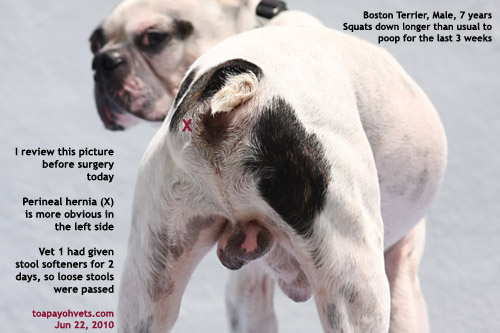
ANAESTHESIA
Domitor and isoflurane gas was OK. The dog recovered smoothly.
SURGERY
I gave him antibiotics to take and schedule perineal hernia surgery 2 days later. The surgery took nearly an hour as the hernia was large.
CONCLUSION
The dog was OK and was warded for at least 4 days as the owner did not have a crate to prevent the dog running loose. I checked the dog every day to ensure that he had proper nursing care and pain-killers. The boy's parents came to visit the dog yesterday. The dog should be back home after 7 days. He had managed to rub his backside onto the floor of the crate despite tolfedine 60 mg at half a tablet per day for 3 days. I decided to give him 1/4 dose of a 30mg phenobarb and then rimadyrl for another 3 days to prevent pain and inflammation.
Updates at www.toapayohvets.com
Tuesday, March 2, 2010
48. Serious heart disease + deep eye ulcer
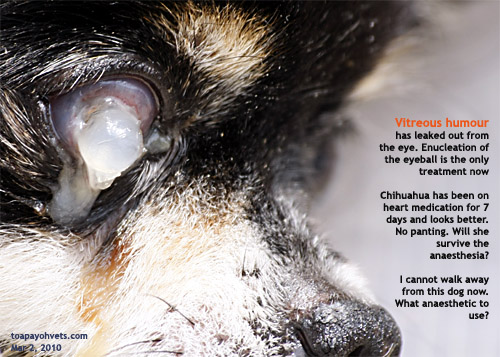
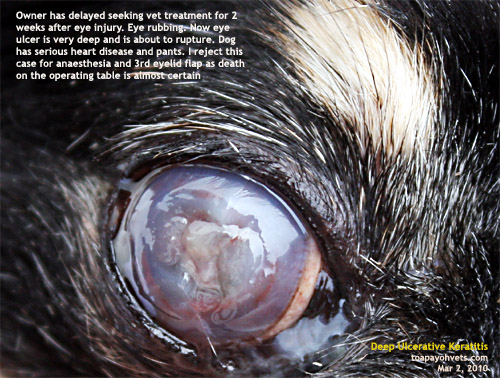
The mother and teenaged daughter adopted the abandoned Chihuahua. For the past 2 weeks, the dog was rubbing her eyes. Dirt and bacteria get trapped inside the eyes, irritating the dog. So, she rubbed more. When I was consulted, the eye cornea was deeply ulcerated. A 3rd eyelid flap would be the surgery and would have saved his eye sight if the owner had not delayed seeking vet treatment.
In addition, this Chihuahua had a serious heart disease. Panting when at rest. More panting when excited. A pre-anaesthetic sedation using Domitor might be too risky.
Therefore, I did not proceed with the surgery as she would likely just die on the operating table. A 90% chance of dying. The owner accepted the risk but since this is a very high risk, I did not want to risk my reputation in handling this case.
The dog went home with heart drug medication, antibiotics, eye ointment and an e-collar. It was better to have a live pet as the teenaged daughter was attached to her. No vet wants a dead dog as a result of anaesthesia. No owner wants that too.
One week later, the eye ulcer had perforated. A white plug of gel oozed out. What to do now? Bacteria would get inside the eye causing enopthalmitis. Uveitis was controlled by eye drops. There was one solution. Surgery to remove the whole eyeball (enucleation).
Performance counts. In this case, a good performance is a live dog at the end of the surgery. The following management of this case is shared with readers and vets:
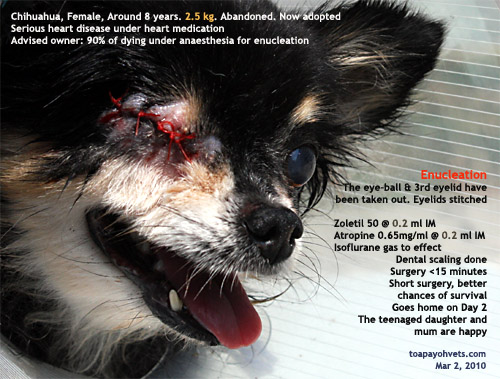
1. Dog was already on Fortekor for the past 7 days. She was no longer panting but dislike direct mask isoflurane gas. Struggled. I did not risk masking her since she might just collapse of heart failure during the fight to get out of the mask. So, a sedation injection was needed. Domitor or zoletil? Which is safer? Does Domitor cause heart rate to slow down? How about xylazine? It causes hypotension. Eventually, I used Zoletil. But how little that can be effective is needed for this 2.5 kg dog?
2. Pre-anaesthetic dextrose saline 20 ml SC and antibiotics.
3. Weight was 2.5 kg. Thin.
Pre-anaesthetic dose of Zoletil 50 @ 0.2 ml IM.
Atropine 0.65mg/ml @ 0.2 ml IM to prevent salivation, neck twisting from Zoletil injection.
Isoflurane gas mask and then intubate.
4. The dog's eyelids were shaved fast. The eyeball was taken out in <10 minutes.
5. The teeth were scaled. 4 loose ones extracted.
6. The dog was on <1% isoflurane gas and was anaesthesized without problems. For a short period, I disconnected the gas and the dog was not awake. So, I could continue surgery. When the dog moved, I re-connect the gas. This close observation and not giving too much anaesthesia ensures the survival of the patient.
7. Post-op dextrose saline 20 ml SC, antibiotics and tolfedine painkillers.
8. Dog went home on Day 2. No problems. Everybody is happy when a dog is alive at the end of surgery and anaesthesia. If the dog had been operated earlier, she would have had died on the operating table as she never had been checked up for heart disease and was not stablised on heart medication. Pictures of the eye injuries are below.
Pic at www.toapayohvets.com
Saturday, February 13, 2010
47. Oxytocin v. elective Caesarean section
If the female dog can't give birth naturally, give an injection of oxytocin and see what happens. This is fine in theory and in lectures.
In private practice, the owner wants a good outcome when he brings in a barrel-shaped Miniature Schnauzer that had difficulty in giving birth to the vet for Caesarean section. With a fully distended abdomen, the Schnauzer is likely to have 5 or 6 puppies. In this case, an X-ray by a vet said 4 puppies but the owner did not bring the X-ray.
Now, what the owner wants is that he gets all puppies alive and ensure that the dam is safe. Oxytocin may or may not work.
If it does not work, there is a long delay which may result in a dead pup or two. If it works, the first pup may be delivered but not every of the 5 pups. A Caesarean section will still be needed and one of the pups may have died in the interim period.
Therefore, in theory, your lecturer advises oxytocin injection to wait and see. Oxytocin does work in some cases but you have to wait. Assuming that the first pup is born 30 minutes after the oxytocin injection, it does not mean that the second pup will follow. If the second pup is born naturally, the 3rd pup may be too big to follow or the dam may be too weak to contract. A few hours pass by. The remaining pups go into distress. When the Caesarean section is performed, one pup may have died. So what? As a vet, you have nothing to lose but your reputation. Some vets don't care about their reputation because deaths are part and parcel of veterinary practice.
In this particular case, at the 6lst day of pregnancy and rectal temperature of 37.1 deg C, I would do an elective Caesarean section. No mucking around with oxytocin to wait and see. It was obvious from the barrel-shaped abdomen that the dam had large pups (X-ray by a vet said 4 pups).
This case was not my case and therefore the judgment to wait after oxytocin injection or do a Caesarean section would be the other vet's judgment. I was an observer. It was Chinese New Year's Eve and my day off as it was also a Saturday. A blue sky, white clouds sunny day.
I did not have a car and taxis would be hard to flag down since most people in Singapore seemed to have closed in the afternoon. The vet in charge decided on a Caesarean section. It was such a bright sunshine afternoon and the lighting would be excellent for beautiful puppy photography. So, I hitched a motor bike ride from Mr Goose to transport me to the other vet practice so that I could take some good pictures of new born puppies. I love taking pictures of neonate puppies. They represent new life.

For the past 20 years, I had never had to ride a bike. I may be a senior citizen but I am still kicking and alive. So I rode pillion behind Mr Goose who is a careful man. His small red bike chugged along as if groaning under my weight. His bike is similar to the ones I show in the picture below. Nothing fanciful.
I put my hands on his shoulders in case I fell off. I hoped for the best. Bike accidents are common in Singapore and here I was taking a calculated risk that no other cars would collide into me from the side or behind.

Mr Goose had one or two minor accidents in the past 10 years and that was considered an excellent safety record. So, I trusted him. So, I had to strain my right hip to get onto the back seat. My backpack with my camera took up some space and so we went down the expressway. Cars whizzed by. I kept my fingers crossed and onto the shoulders of Mr Goose. I tried to maintain an upright posture as he swerved and turn to reach the practice.
The wind from Mr Groove's helmet whistled into my helmeted ears. The afternoon sky was blue. White cotton clouds dotted the sky and bright sunshine radiated downwards as I enjoyed the fresh breeze. Fortunately, it was not a rainy day and we arrived safely.
All 5 puppies were delivered by Caesarean section by the vet. I took a few pictures. This was a day full of happy memories for of a Chinese New Year's Eve on a very rare instance when I got onto a motor bike.
Births of new pups are always wonderful. New born pups are hard to photograph. The evening sunshine was what I wanted to get a good picture. Now it was up to my expertise to produce some for readers. I did not have to use Photoshop to touch up. There were some of my favourite pictures. I hope the readers enjoy them and wish all a Happy Chinese New Year 2010.
I am quite sure that the family of 5 Miniature Schnauzer pups must be having a very happy New Year too. I don't know them nor did I meet them as this was not my case. Senior citizens do not need to behave and walk as if they have one foot in the grave. Be alive. Think alive. Old age does not mean impending death. Live life as if every day is our last day on earth. We are not youthful but we should feel brand new and share our experiences with the young ones. Today is Chinese New Year and Valentine's Day. I hope you have a good holiday.
In private practice, the owner wants a good outcome when he brings in a barrel-shaped Miniature Schnauzer that had difficulty in giving birth to the vet for Caesarean section. With a fully distended abdomen, the Schnauzer is likely to have 5 or 6 puppies. In this case, an X-ray by a vet said 4 puppies but the owner did not bring the X-ray.
Now, what the owner wants is that he gets all puppies alive and ensure that the dam is safe. Oxytocin may or may not work.
If it does not work, there is a long delay which may result in a dead pup or two. If it works, the first pup may be delivered but not every of the 5 pups. A Caesarean section will still be needed and one of the pups may have died in the interim period.
Therefore, in theory, your lecturer advises oxytocin injection to wait and see. Oxytocin does work in some cases but you have to wait. Assuming that the first pup is born 30 minutes after the oxytocin injection, it does not mean that the second pup will follow. If the second pup is born naturally, the 3rd pup may be too big to follow or the dam may be too weak to contract. A few hours pass by. The remaining pups go into distress. When the Caesarean section is performed, one pup may have died. So what? As a vet, you have nothing to lose but your reputation. Some vets don't care about their reputation because deaths are part and parcel of veterinary practice.
In this particular case, at the 6lst day of pregnancy and rectal temperature of 37.1 deg C, I would do an elective Caesarean section. No mucking around with oxytocin to wait and see. It was obvious from the barrel-shaped abdomen that the dam had large pups (X-ray by a vet said 4 pups).
This case was not my case and therefore the judgment to wait after oxytocin injection or do a Caesarean section would be the other vet's judgment. I was an observer. It was Chinese New Year's Eve and my day off as it was also a Saturday. A blue sky, white clouds sunny day.
I did not have a car and taxis would be hard to flag down since most people in Singapore seemed to have closed in the afternoon. The vet in charge decided on a Caesarean section. It was such a bright sunshine afternoon and the lighting would be excellent for beautiful puppy photography. So, I hitched a motor bike ride from Mr Goose to transport me to the other vet practice so that I could take some good pictures of new born puppies. I love taking pictures of neonate puppies. They represent new life.

For the past 20 years, I had never had to ride a bike. I may be a senior citizen but I am still kicking and alive. So I rode pillion behind Mr Goose who is a careful man. His small red bike chugged along as if groaning under my weight. His bike is similar to the ones I show in the picture below. Nothing fanciful.
I put my hands on his shoulders in case I fell off. I hoped for the best. Bike accidents are common in Singapore and here I was taking a calculated risk that no other cars would collide into me from the side or behind.

Mr Goose had one or two minor accidents in the past 10 years and that was considered an excellent safety record. So, I trusted him. So, I had to strain my right hip to get onto the back seat. My backpack with my camera took up some space and so we went down the expressway. Cars whizzed by. I kept my fingers crossed and onto the shoulders of Mr Goose. I tried to maintain an upright posture as he swerved and turn to reach the practice.
The wind from Mr Groove's helmet whistled into my helmeted ears. The afternoon sky was blue. White cotton clouds dotted the sky and bright sunshine radiated downwards as I enjoyed the fresh breeze. Fortunately, it was not a rainy day and we arrived safely.
All 5 puppies were delivered by Caesarean section by the vet. I took a few pictures. This was a day full of happy memories for of a Chinese New Year's Eve on a very rare instance when I got onto a motor bike.
Births of new pups are always wonderful. New born pups are hard to photograph. The evening sunshine was what I wanted to get a good picture. Now it was up to my expertise to produce some for readers. I did not have to use Photoshop to touch up. There were some of my favourite pictures. I hope the readers enjoy them and wish all a Happy Chinese New Year 2010.
I am quite sure that the family of 5 Miniature Schnauzer pups must be having a very happy New Year too. I don't know them nor did I meet them as this was not my case. Senior citizens do not need to behave and walk as if they have one foot in the grave. Be alive. Think alive. Old age does not mean impending death. Live life as if every day is our last day on earth. We are not youthful but we should feel brand new and share our experiences with the young ones. Today is Chinese New Year and Valentine's Day. I hope you have a good holiday.
Thursday, February 11, 2010
46. Breast tumours in an old spayed cat
"Can I get some medicine for my cat?" the man came to Toa Payoh Vets and showed me a handphone picture of his 10-year-old cat with a large growth.
"Your cat appears to have breast tumours," I said. "No drugs can make them disappear. She needs surgery. What cream did you apply onto the tumours? Is she still eating?"
"I applied some antiseptic cream. My cat eats very little for the past 2 weeks," the man showed 1 cm width between his forefinger and thumb of his right hand.
What can be done now? Surgery would be the answer. There was the cost. More important this was a high-risk anaesthetic case as the cat had lost appetite for 2 weeks. Surprisingly, her temperature was normal. She was thin. I informed the owner that the cat could just die on the operating table due to her poor health. The pre-blood test was not done to save veterinary costs.
The following was done for this cat on the day she was admitted.
CONSULTATION. To enhance her survival chances, I injected baytril, anti-fever and anti-spasm drugs in 10 ml dextrose saline SC and had to decide whether to operate 2 hours later or wait till the next day. This was a difficult judgment. I decided to operate 2 hours later as the cat was not eating but her rectal temperature was normal. IV glucose was given first and continued during surgery.
PRE-ANAESTHETIC SEDATION Zoletil 50 @ 0.1 ml IV. The cat shot out a paw wanting to scratch my assistant Mr Saw when he put the Zoletil bottle noisily on the table. Today, Mr Saw seemed to be noisy. The cat had hissed at him before that. This was surprisingly as she did not behave similarly towards me and my second veterinary assistant Mr Goose.
"Maybe you are too noisy," I said. Mr Goose said as he grasped the scruff of the cat's neck and held the hind leg for IV injection of Zoletil. "Cats and rabbits at the preparation room for surgery get nervous when the place is noisy."
(In retrospect as I type this report at 5.46 am on Friday Feb 12, 2010, the cat could be defending herself from being given antiseptic ointment by her owner who had cleaned her breast tumours for some time. Her owner had a dark complexion like Mr Saw. This was one explanation as the cat associated Mr Saw with her owner and knew that she would be applied antiseptic ointment. It must be painful getting this application.)
Mr Goose pressed the medial side of the thigh to bring out a dark blue vein. Zoletil 0.1 ml IV is safe for this 2 kg cat. She was sedated. She had an IV glucose drip in her forearm prior to this sedation.
Gas mask isoflurane anaesthesia after this gave her freedom from pain during surgery. 3 minutes before the end of surgery, the isoflurane gas was cut off. The cat was given oxygen to breathe.
SURGERY
Two things to note:
1. The wound was very large as the tumours were scattered. Ensure sufficient skin to stitch up.
2. Bleeding from the superficial epigastric arteries (cranial around MG1 and MG2 and caudal around MG4 and MG5). Clamp the bleeding points and ligate.
3. Subcutaneous fat stitched to provide less tension for the skin.
4. Skin stitched.
5. Body wrapped. E-collar.
POST-OP CARE
The cat was very weak and slept. I checked her tongue at the end of surgery. It was bright pink as she had been given glucose IV. Glucose by IV drip is necessary for such cases to have a chance of survival under general anaesthetic. Continue IV drip of dextrose saline and Hartmann's solution over the next 24 hours.
Will the cat survive? It is hard to say. Goto: www.toapayohvets.com for updates.
TIPS FOR OLD OWNERS
This is a case where a spayed cat still gets breast tumours. Spaying reduces the incidence and most spayed cats and dogs don't get breast tumours.
It is a matter of probability rather than a guarantee that spaying will prevent mammary tumours in old age.
It is best to get breast tumours in cats and dogs removed by your vet when they are much smaller. It will be less costly. I can give a high discount for some cases with financial distress. I can't do it for every case as it is costly for the surgery and post-operation complications and nursing for the next 7-14 days. Big tumours of the mammary glands get ulcerated and infected. The cat would then stop eating and die a painful death.
"Your cat appears to have breast tumours," I said. "No drugs can make them disappear. She needs surgery. What cream did you apply onto the tumours? Is she still eating?"
"I applied some antiseptic cream. My cat eats very little for the past 2 weeks," the man showed 1 cm width between his forefinger and thumb of his right hand.
What can be done now? Surgery would be the answer. There was the cost. More important this was a high-risk anaesthetic case as the cat had lost appetite for 2 weeks. Surprisingly, her temperature was normal. She was thin. I informed the owner that the cat could just die on the operating table due to her poor health. The pre-blood test was not done to save veterinary costs.
The following was done for this cat on the day she was admitted.
CONSULTATION. To enhance her survival chances, I injected baytril, anti-fever and anti-spasm drugs in 10 ml dextrose saline SC and had to decide whether to operate 2 hours later or wait till the next day. This was a difficult judgment. I decided to operate 2 hours later as the cat was not eating but her rectal temperature was normal. IV glucose was given first and continued during surgery.
PRE-ANAESTHETIC SEDATION Zoletil 50 @ 0.1 ml IV. The cat shot out a paw wanting to scratch my assistant Mr Saw when he put the Zoletil bottle noisily on the table. Today, Mr Saw seemed to be noisy. The cat had hissed at him before that. This was surprisingly as she did not behave similarly towards me and my second veterinary assistant Mr Goose.
"Maybe you are too noisy," I said. Mr Goose said as he grasped the scruff of the cat's neck and held the hind leg for IV injection of Zoletil. "Cats and rabbits at the preparation room for surgery get nervous when the place is noisy."
(In retrospect as I type this report at 5.46 am on Friday Feb 12, 2010, the cat could be defending herself from being given antiseptic ointment by her owner who had cleaned her breast tumours for some time. Her owner had a dark complexion like Mr Saw. This was one explanation as the cat associated Mr Saw with her owner and knew that she would be applied antiseptic ointment. It must be painful getting this application.)
Mr Goose pressed the medial side of the thigh to bring out a dark blue vein. Zoletil 0.1 ml IV is safe for this 2 kg cat. She was sedated. She had an IV glucose drip in her forearm prior to this sedation.
Gas mask isoflurane anaesthesia after this gave her freedom from pain during surgery. 3 minutes before the end of surgery, the isoflurane gas was cut off. The cat was given oxygen to breathe.
SURGERY
Two things to note:
1. The wound was very large as the tumours were scattered. Ensure sufficient skin to stitch up.
2. Bleeding from the superficial epigastric arteries (cranial around MG1 and MG2 and caudal around MG4 and MG5). Clamp the bleeding points and ligate.
3. Subcutaneous fat stitched to provide less tension for the skin.
4. Skin stitched.
5. Body wrapped. E-collar.
POST-OP CARE
The cat was very weak and slept. I checked her tongue at the end of surgery. It was bright pink as she had been given glucose IV. Glucose by IV drip is necessary for such cases to have a chance of survival under general anaesthetic. Continue IV drip of dextrose saline and Hartmann's solution over the next 24 hours.
Will the cat survive? It is hard to say. Goto: www.toapayohvets.com for updates.
TIPS FOR OLD OWNERS
This is a case where a spayed cat still gets breast tumours. Spaying reduces the incidence and most spayed cats and dogs don't get breast tumours.
It is a matter of probability rather than a guarantee that spaying will prevent mammary tumours in old age.
It is best to get breast tumours in cats and dogs removed by your vet when they are much smaller. It will be less costly. I can give a high discount for some cases with financial distress. I can't do it for every case as it is costly for the surgery and post-operation complications and nursing for the next 7-14 days. Big tumours of the mammary glands get ulcerated and infected. The cat would then stop eating and die a painful death.
Subscribe to:
Posts (Atom)